
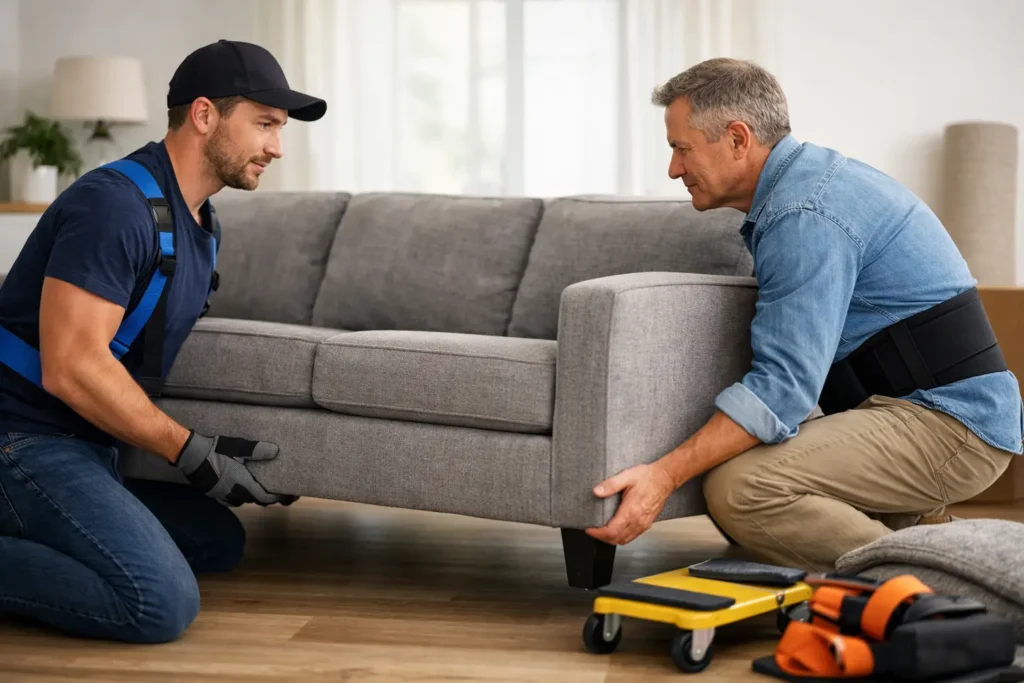
A sofa that looked perfectly manageable in the showroom can feel impossible once it is wedged in a narrow hallway. Heavy furniture is awkward as well as heavy, and most moving injuries happen when people rush, twist, or try to prove they can manage alone. Knowing how to move heavy furniture safely starts with preparation, not brute strength.
Whether you are moving a single dresser between rooms, relocating from an apartment, or clearing an office, a little planning protects your back, your walls, and the furniture itself. Some jobs are suitable for a careful DIY approach. Others are safer, faster, and better handled by trained movers.
Start by Planning the Route
Before lifting anything, measure the furniture and the path it needs to travel. Check doorways, hallways, stairwells, elevators, turns, and the space inside the moving vehicle. A piece that fits through a doorway may still be difficult to rotate around a landing.
Clear the route completely. Remove rugs that can slide, shoes and boxes from hallways, low-hanging pictures, and anything that could catch a corner of the furniture. Protect vulnerable areas with moving blankets, cardboard, or corner guards where needed. This small amount of prep prevents the frustrating stop-start movement that causes scrapes and strains.
It also helps to decide where the item will go before you pick it up. Mark out a clear landing area in the new room or vehicle so nobody is holding a heavy load while asking where it should be placed.
Make Heavy Furniture Lighter First
Furniture should be as light and compact as possible before it moves. Empty drawers, shelves, cabinets, and compartments completely. Books, dishes, files, and tools add more weight than most people expect, and they can shift during lifting.
Remove what you safely can. Take off cushions, glass shelves, detachable legs, headboards, and removable doors. Wrap loose hardware in a labeled bag and tape it securely to the corresponding item, not to a finished wood surface. For a large wardrobe or entertainment center, partial disassembly may turn an unsafe job into a manageable one.
Be realistic, though. Taking apart furniture is not always the best answer. Flat-pack pieces can weaken if dismantled repeatedly, while older furniture may have fragile joints. If you are unsure whether an item can be disassembled without damage, move it intact with the right equipment or arrange professional support.
Use Equipment Instead of Muscle
The right moving tools reduce both effort and risk. Furniture sliders are useful for moving sofas, cabinets, and tables across carpet, hardwood, or tile floors. Choose sliders designed for your floor type, and keep the route clear so the furniture does not snag.
A hand truck or furniture dolly is ideal for boxes, appliances, filing cabinets, and smaller solid pieces. Larger items may require a four-wheel furniture dolly, moving straps, and moving blankets. Straps help distribute weight between two people, but only when both people understand how to use them and can communicate clearly.
Moving blankets do more than prevent scratches. They create a protective layer around corners, reduce friction against door frames, and help secure furniture in a truck. Use stretch wrap to hold blankets in place, but do not wrap leather or delicate wood tightly for long periods, especially in warm conditions where moisture can become trapped.
How to Move Heavy Furniture With a Partner
Most large furniture should never be moved by one person. A reliable partner makes the job safer, but teamwork only works when both people agree on the plan before lifting.
Assign one person to call the movement. Use simple instructions such as “lift,” “stop,” “left,” “down,” and “set.” The person walking backward should be guided carefully, particularly near stairs, curbs, and door thresholds. Never carry a bulky item so high that it blocks the view of the person moving backward.
Lift with your legs, keeping your back as straight as possible and holding the load close to your body. Avoid twisting at the waist. Instead, take small steps and turn your whole body. If the piece feels unstable, too heavy, or difficult to grip, put it down safely and rethink the approach. There is no benefit in forcing a lift that could cause an injury.
For tall items such as bookcases and wardrobes, keep them upright when practical and secure doors and drawers first. For sofas, angle and pivot rather than trying to carry the full weight at arm’s length. Each item has its own balance point, so take a moment to find it before committing to the move.
Stairs Need Extra Caution
Stairs are where a routine move can become dangerous. Do not attempt to carry heavy furniture up or down stairs alone. Use at least two capable people, clear the stairway, and take each step slowly.
Keep the heavier end lower on the stairs whenever possible, but do not rely on a general rule if it makes the furniture harder to control. The safest orientation depends on the item, the stair angle, and the available handrails and turns. If there is any doubt, especially with a large sofa, piano, safe, appliance, or solid wood wardrobe, professional movers are the sensible choice.
Protect Floors, Walls, and the Furniture
A successful move is not just about getting an item from one place to another. It is about getting it there without damaged floors, chipped paint, broken legs, or torn upholstery.
Use sliders on floors and blankets around sharp corners. Tape down protective floor covering if people will be walking in and out repeatedly. Keep hands away from pinch points under furniture and between furniture and walls. When setting a piece down, lower it together and make sure everyone’s fingers are clear before releasing it.
In a moving truck, place heavy furniture against the walls and toward the front, distributing weight evenly from side to side. Use proper straps to prevent movement in transit. Do not stack heavy items on delicate tables, upholstered furniture, or boxes labeled fragile. A well-loaded vehicle is safer to drive and much less likely to leave you with damaged belongings at the other end.
Know When to Call Professional Movers
There is a point where hiring help is not an added expense – it is protection for your health, property, and schedule. Professional movers are particularly valuable when furniture must travel through tight staircases, apartment buildings, busy city streets, or properties with limited parking.
Consider booking trained movers if the item is unusually heavy, valuable, fragile, or hard to maneuver. This includes oversized sectionals, antique furniture, pool tables, large appliances, commercial desks, filing cabinets, and specialty items. It is also worth getting help if you have a back injury, are short on time, or do not have enough capable people available on moving day.
A flexible moving service can be useful even if you do not need a full-house move. You may only need a man-and-van team for a few large pieces, loading assistance, furniture transport, or help with a small office relocation. Dencomovers provides tailored moving support for customers who want experienced handling without taking on the physical strain themselves.
A Quick Safety Check Before You Lift
Before each major lift, pause for a few seconds. Confirm the route is clear, the furniture is empty, the protective materials are in place, and everyone knows where the item is going. Check that you have a firm grip and that no drawer, door, or loose part can swing open.
Do not move heavy furniture when you are exhausted, rushed, or working in poor lighting. Delay the task, add another helper, or arrange professional assistance. A careful decision before the lift is far easier than dealing with an injury or damaged furniture afterward.
Heavy furniture does not have to turn moving day into a painful ordeal. Take the weight seriously, use the right tools, and ask for help before the job becomes too much. The best move is the one that gets everyone and everything to the new space safely.