
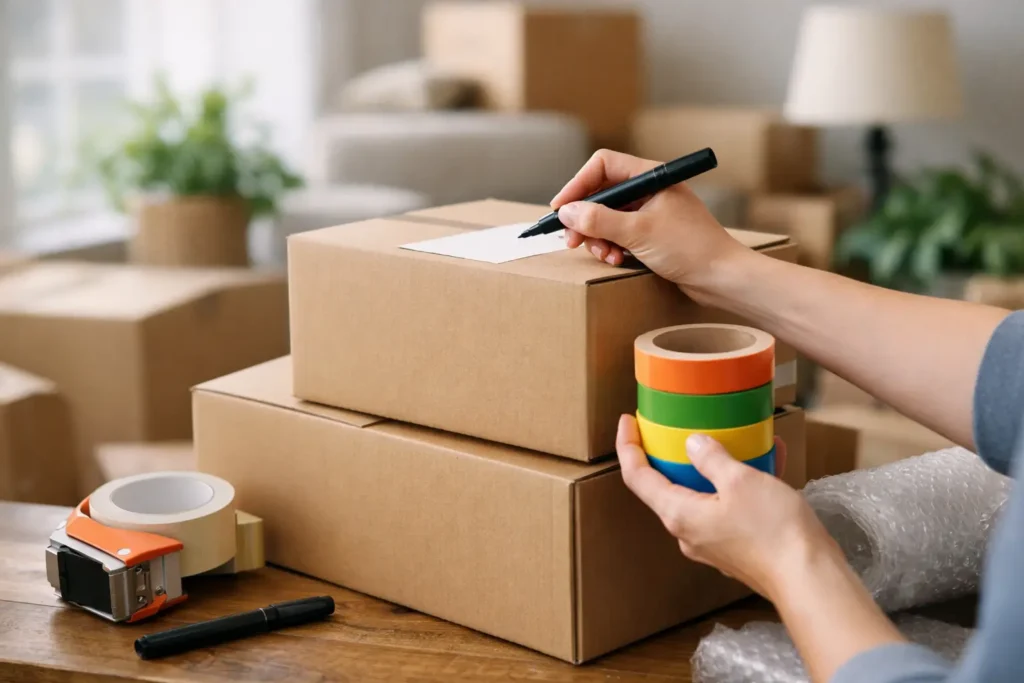
A box marked simply “Kitchen” can still leave you hunting through six cartons for a coffee mug, charger, or frying pan on moving day. Knowing how to label moving boxes properly gives you and your movers clear direction, protects delicate belongings, and makes the first night in your new place far less chaotic.
The goal is not to create a complicated filing system. It is to make every box easy to identify at a glance, whether it is in your current home, on the truck, or stacked in its new room. A clear label saves time at every stage of the move.
Start With One Simple Labeling System
Choose your system before packing the first box and use it consistently. The most practical approach combines the destination room, a short description of contents, handling instructions, and a priority level. You can write directly on the box with a thick permanent marker, use adhesive labels, or do both.
A strong label might read: “KITCHEN – Everyday Plates and Mugs – OPEN FIRST.” That tells everyone where the box goes, what is inside, and how soon you will need it. “Living Room – Cables” is much more useful than “Miscellaneous,” which tends to become a mystery box when unpacking starts.
For each box, include these four details:
- The destination room in large, bold lettering
- A brief but specific description of the contents
- Handling instructions, if needed, such as “FRAGILE” or “THIS SIDE UP”
- An unpacking priority, such as “Open First,” “Week One,” or “Storage”
Keep room names consistent. If you call it “Main Bedroom” on one box, do not label the next three “Master,” “Bedroom,” and “Upstairs Room.” Consistent wording helps movers place boxes quickly and prevents items being left in the wrong area.
How to Label Moving Boxes by Room
Room labels should be the largest part of every label. Use all capital letters or a bold marker color that stands out from a few feet away. Place the room name on at least two sides of the box, not only on the top. Once boxes are stacked, top labels are often hidden.
For homes with more than one bedroom or bathroom, add a clear identifier. “Bedroom” is not enough in a three-bedroom house. Use “Primary Bedroom,” “Child’s Bedroom,” “Guest Bedroom,” or “Upstairs Bathroom.” If your new home has rooms with different names or layouts, label according to the destination rather than the current room whenever possible.
This is especially helpful if you are moving into a smaller property, combining households, or placing some belongings in storage. A box packed in the spare bedroom may ultimately belong in the office, garage, or storage unit. Label it for where it needs to go next.
Use Color as a Backup, Not the Whole System
Colored tape, stickers, or markers can make sorting faster. For example, use blue for the kitchen, green for the living room, yellow for bathrooms, and red for bedrooms. Put a matching colored sign on the door frame of each room in the new property so your moving team can quickly identify the correct destination.
Color should support written labels, not replace them. Tape can tear, colors may be hard to distinguish in poor light, and not everyone sees colors the same way. Every box still needs a written room name and contents description.
Describe Contents Without Writing an Inventory Novel
You do not need to list every spoon, book, or sweater inside a box. But vague descriptions create unnecessary work later. Instead of “Books,” write “Books – Cookbooks and Recipe Files.” Instead of “Bathroom,” write “Bathroom – Towels and Toiletries.”
Specific descriptions are most valuable for items you are likely to need quickly or items that are easy to misplace. Think electronics accessories, children’s school supplies, medication, work materials, remote controls, hardware, and kitchen essentials.
A useful rule is to describe the category and the most important item inside. “Office – Laptop Dock and Files” or “Hall Closet – Cleaning Supplies” gives you enough information without slowing down your packing.
Avoid writing highly sensitive details on the outside of boxes. For example, rather than “Passport and Tax Records,” use “Home Office – Personal Files.” Important documents, valuables, prescription medication, and small electronics are usually safest kept with you during the move rather than packed on the truck.
Mark Fragile Boxes Clearly and Honestly
“FRAGILE” should be written in large letters on multiple sides of any box containing glassware, dishes, mirrors, lamps, artwork, or delicate electronics. Add “THIS SIDE UP” with arrows where the box must remain upright, such as boxes carrying stemware or certain appliances.
However, a fragile label is not a substitute for careful packing. A box should be strong enough for its contents, filled so items cannot shift, and sealed securely. Overpacked boxes can split even when labeled correctly, while a lightly packed box may be crushed if it has empty space inside.
It also helps to identify unusually heavy boxes. Mark “HEAVY – BOOKS” or “HEAVY – TOOLS” so no one is surprised when lifting them. Keep heavy boxes manageable rather than trying to fill every available inch. Smaller boxes are usually the better choice for books, records, tools, and other dense items.
Create an Open-First Plan
The first 24 hours after a move are easier when your essentials are clearly separated from everything else. Pack one or more “Open First” boxes for each household, and make those labels impossible to miss.
Your essentials may include toilet paper, soap, towels, bedding, a basic toolkit, chargers, coffee supplies, snacks, cleaning products, pet items, and a few dishes. Families may also need diapers, favorite toys, school items, or a simple set of clothes for the next day. What belongs in these boxes depends on your household, but the label should make the priority clear.
For a local move, you might keep these boxes with the main load but ask for them to be unloaded first. For a longer move or a move with several stops, consider taking the most critical essentials in your own vehicle. That removes uncertainty if unloading takes longer than expected.
Number Boxes and Keep a Simple Inventory
Numbering boxes is worthwhile when you have a larger home, an office move, storage items, or several boxes going to the same room. Write a number alongside the room label, such as “Kitchen 1 of 8” or “Office 3 of 12.”
You can then keep a simple note on your phone or a paper checklist. It does not need to be detailed. A record such as “Kitchen 4 – Glasses and serving bowls” can help you find what you need without opening multiple boxes.
For small-business moves, numbering is even more useful. Label boxes by department, workstation, or destination area, such as “Reception – Supplies – Box 2 of 5.” If equipment is being packed separately from documents, make that distinction obvious. Clear labeling helps staff settle in faster and reduces the risk of essential items ending up in the wrong office.
Label as You Pack, Not at the End
The most common labeling mistake is waiting until all boxes are sealed. By then, packing fatigue has set in, boxes look alike, and details are forgotten. Label each box as soon as you know what is going inside, then add the contents description before sealing it.
Keep your marker and labels in the same place as your packing tape. If several people are helping, agree on the room names and priority terms before they begin. A shared system prevents one person using abbreviations that nobody else understands.
Before moving day, walk through the home and check that every sealed box has labels on visible sides. Remove or cover old shipping labels and reused-box markings that could cause confusion. This small check can prevent a surprising amount of unloading delay.
Make Labels Work With Your Moving Team
Professional movers can move more efficiently when labels are easy to read and placed consistently. They can load heavier boxes appropriately, keep fragile items protected, and take each box directly to its intended room rather than stopping to ask questions.
If there are access issues, unusual items, or boxes that must go to storage instead of the new home, tell your moving team before loading begins. A label can say “Storage,” but a quick conversation makes the plan clearer. Dencomovers can also support packing and handling when you want experienced help preparing a move that feels organized from the start.
A well-labeled box is a small piece of preparation that pays off repeatedly. When you are tired, surrounded by cartons, and trying to make a new place feel like home, clear words on the side of a box can be exactly the help you need.