
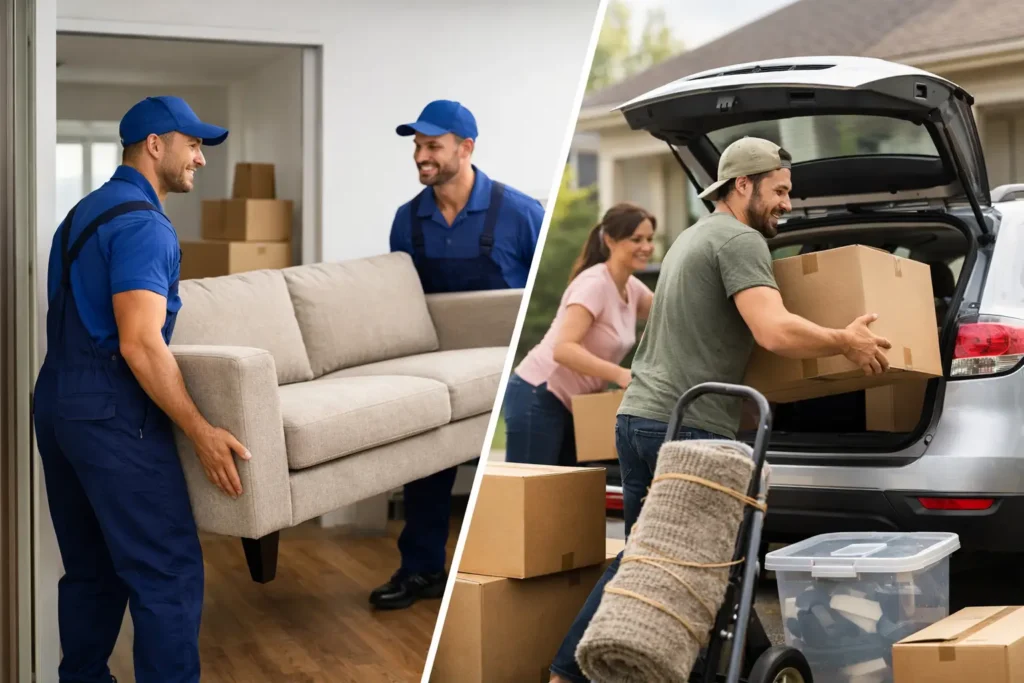
A flat move can look simple on paper. A few rooms, a short list of furniture, maybe just one flight of stairs. Then moving day arrives, the elevator is booked for a narrow window, the sofa does not turn the hallway corner, and the “quick trip” becomes an all-day job.
That is why the flat movers vs self move question matters more than many people expect. The cheaper option is not always the one with the lowest upfront price, and the easier option depends on your schedule, your building, and how much risk you are willing to carry yourself.
Flat movers vs self move: what are you really comparing?
At first glance, the comparison seems straightforward. Hiring flat movers means paying professionals to handle packing, loading, transportation, and unloading, while a self move means renting a van or borrowing a vehicle, finding helpers, and doing the work yourself.
In reality, you are comparing much more than labor. You are comparing time, physical effort, injury risk, damage risk, parking logistics, equipment access, and how much disruption you can absorb during the move. For a studio apartment with minimal furniture, self-moving may be perfectly reasonable. For a larger flat, a building with strict access rules, or a move squeezed into a workweek, professional support often changes the entire experience.
When a self move makes sense
A self move usually makes the most sense when the move is small, local, and flexible. If you have only a few boxes, limited furniture, and a short driving distance, handling it yourself can be a smart way to control costs.
It also works better when your move is low-pressure. If you can pick up keys early, move over a day or two, and avoid tight building schedules, you have room for delays. That breathing space matters. A self move becomes far more difficult when every hour is timed around elevator reservations, loading zones, or lease deadlines.
Budget is another clear factor. Many renters look at professional moving quotes and immediately compare them with a van rental fee. On the surface, self-moving often looks cheaper. If you already have strong friends willing to help, basic packing supplies, and easy access at both locations, it may well be.
Still, the true cost depends on whether everything goes as planned. Extra fuel, mileage fees, insurance add-ons, equipment rental, parking tickets, damaged furniture, and replacing a lost workday can quickly narrow the gap.
Where flat movers usually win
Professional flat movers tend to offer the most value when the move includes heavy items, access challenges, or a narrow timeline. Apartments and flats often involve stairs, hallways, loading restrictions, and limited parking. Those details are exactly where experience matters.
A trained moving team knows how to protect furniture, maneuver awkward items, and load a vehicle efficiently. That may sound basic, but efficiency is where a lot of moving-day stress disappears. Instead of making multiple trips, guessing how to secure a mattress, or struggling with a chest of drawers on the stairwell, you get a process that is already organized.
That support becomes even more valuable if you are moving while working full time, managing children, or trying to coordinate a small office relocation. In those cases, paying for help is not just about convenience. It is about reducing disruption and keeping the move from spilling into the rest of your week.
Cost: the part everyone focuses on first
Cost matters, and it should. But flat movers vs self move is not a simple question of cheap versus expensive.
A self move often has lower direct costs. You may pay for van rental, fuel, moving blankets, a dolly, boxes, tape, and perhaps food for friends helping out. If the move is short and small, that can still be a sensible total.
Professional movers cost more upfront because you are paying for labor, transport, handling skill, and speed. But that higher price often includes things people forget to cost into a DIY move, such as equipment, route planning, protective materials, and a team that can complete in hours what might take you a full day or weekend.
There is also the cost of mistakes. A damaged TV stand, a gouged apartment wall, or a pulled back muscle can make a budget move expensive very quickly. If your building charges for damage or your landlord withholds part of a deposit, savings disappear fast.
For many customers, the right question is not “Which option is cheapest?” but “What am I actually paying to avoid?” If the answer includes stress, injury, delays, and damage, professional movers can be the more economical choice overall.
Time and energy are part of the price
People often underestimate how draining a move is before the first box is even loaded. Packing takes longer than expected. Taking furniture apart takes longer than expected. Driving, unloading, and reassembling everything takes longer than expected.
A self move asks you to manage every stage yourself. That includes planning, sourcing supplies, coordinating help, driving, lifting, and solving problems as they appear. If you are organized and your move is simple, that can be manageable. If not, it can become exhausting very quickly.
Flat movers remove a large part of that burden. You are not just paying for muscle. You are paying for less decision-making under pressure. That matters when moving day is already full of deadlines, handovers, and unexpected issues.
Risk is where the gap gets wider
Every move carries some risk, but a self move puts more of it directly on you. If a friend drops a dresser, if you scrape a hallway wall, or if your rental van is packed poorly and items shift in transit, you are the one dealing with the result.
Professional movers bring training and, in many cases, insurance coverage that adds peace of mind. That does not mean accidents never happen, but it does mean the move is being handled by people who move furniture regularly and understand how to protect it properly.
This is especially important for fragile items, large furniture, electronics, or anything with real replacement value. It also matters in apartment buildings, where access is tight and one wrong angle can damage both the item and the property.
For risk-aware customers, this is often the deciding factor. A move is already a major transition. Most people do not want to add avoidable uncertainty to it.
The building itself often decides for you
Flat moves are not all the same. A ground-floor unit with open parking is one thing. A fourth-floor walk-up with a narrow staircase is something else entirely.
Building logistics have a huge impact on whether self-moving is realistic. If your property has loading bay rules, elevator reservations, limited moving hours, or long carry distances from vehicle to entrance, professional movers usually have the advantage. They are better equipped to work within those limits and keep the move on schedule.
If access is easy and your items are minimal, self-moving may still be practical. But once the building starts adding friction, the gap between the two options becomes much clearer.
A middle ground often works best
The choice is not always all or nothing. Many people benefit from a partial service approach.
For example, you might pack your own boxes to save money, then hire movers for loading, transportation, and heavy lifting. Or you may only need a man-and-van style service for a smaller flat move, rather than a full-service crew. That can keep costs controlled while still removing the hardest part of the job.
This middle option is often ideal for renters and small households who want support without paying for services they do not need. It gives you flexibility while still reducing the main pressures of moving day.
That is one reason companies like Dencomovers appeal to practical customers. Flexible service matters because not every move fits a standard package.
So, which option is right for you?
If your move is small, low-risk, and you have time, help, and easy access, a self move can absolutely work. It may save money, and for some people, that savings is worth the effort.
If your move includes bulky furniture, time pressure, difficult access, or items you cannot afford to damage, flat movers usually offer better value than the price alone suggests. You get speed, support, and a more controlled process.
The best choice depends on what your move is asking from you. Not just your wallet, but your body, your time, and your tolerance for stress. A smart move is not always the one with the lowest quote. It is the one that gets you into your new place with the least disruption and the fewest regrets.
Before you decide, picture the actual day, not just the estimate. That is usually where the right answer becomes obvious.